
The Quantum Threat to Ethereum Is Already Here — and You Can’t Patch It

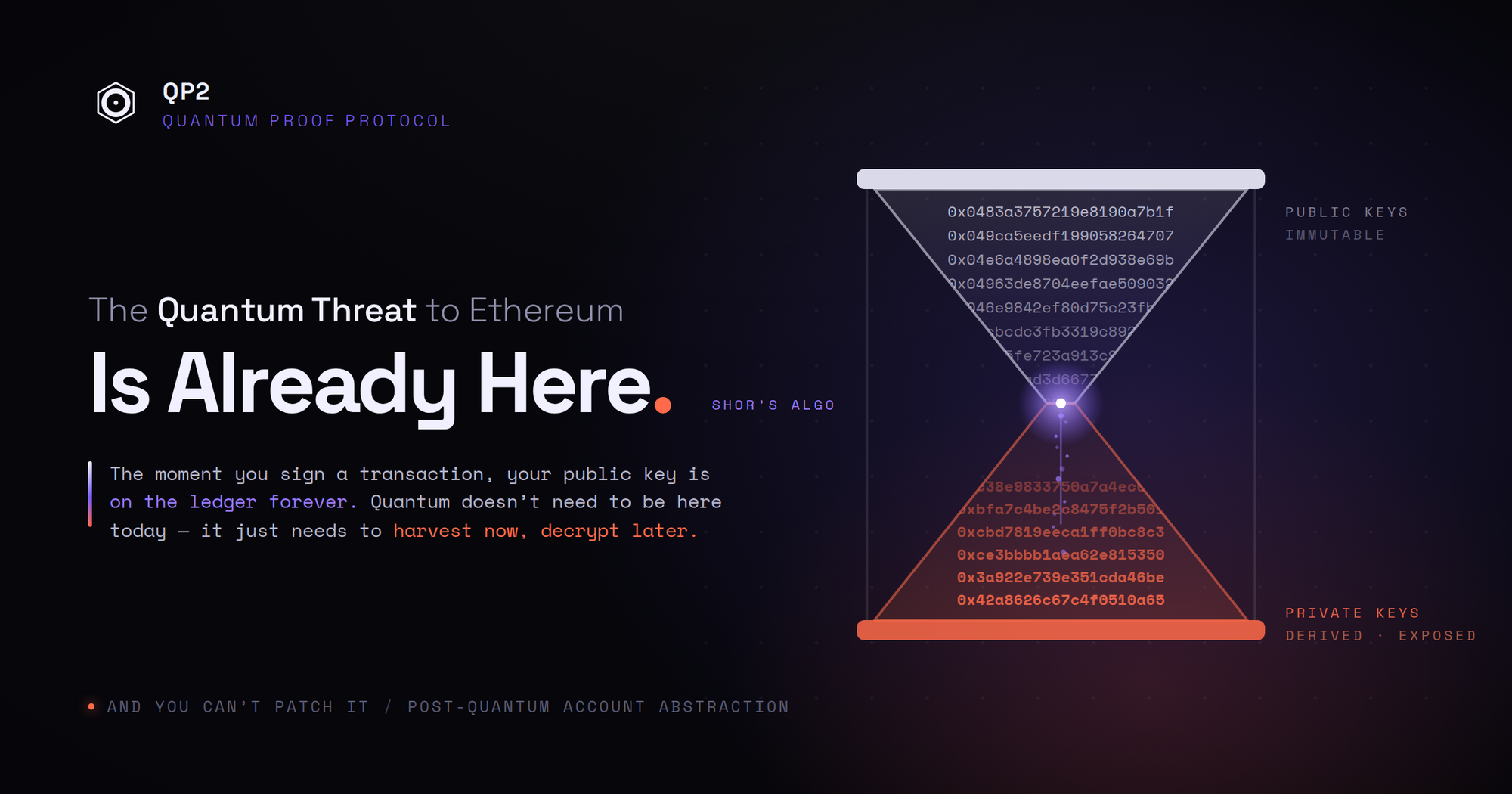
Here's an uncomfortable fact about your crypto wallet: it has a weakness that no software update will ever fix.
It's not a bug in MetaMask. It's not a sketchy smart contract. It's baked into the cryptography that every single Ethereum address is built on — and one day a quantum computer cracks it wide open.
People have been waving this away for years. "Quantum? That's a decade out, relax." I used to think roughly the same thing. Then the numbers changed, and they changed fast. So before we get to what we built to fix this, let me walk you through why this stopped being a someday problem.
This is the first post from the team behind QP2 (Quantum Proof Protocol).
So how does quantum actually break your wallet?
Your Ethereum account is locked with ECDSA — elliptic-curve cryptography. Your private key signs things, your public key lets everyone check the signature. The whole thing holds together on one promise: nobody can work backwards from your public key to your private key.
A normal computer can't. Not in a billion years, literally. But a big enough quantum computer running Shor's algorithm can do it in minutes. Shor's is basically a cheat code for exactly this kind of math.
And here's the part that should bother you more than it probably does: every time you send a transaction, you splash your public key onto the chain forever. Blockchains don't forget. They can't. So the one piece of information an attacker needs is already sitting out in the open, permanently, for tens of millions of accounts. The latest counts put it north of 20 million Ethereum accounts that have already exposed theirs.
You can't un-send those transactions. The key is out there.
"It's years away" — okay, but that's not how this attack works
The standard comeback is that the hardware's still years off, so why panic now. For most things, fair enough. For blockchains, it falls apart.
The attack is called harvest now, decrypt later, and it's exactly as grim as it sounds. The attacker doesn't need a quantum computer today. They need a hard drive. They scrape your exposed public keys right now — costs nothing, leaves no fingerprints — and they just sit on them until the hardware shows up. Because the ledger is permanent, a key you exposed back in 2019 is every bit as crackable now as it'll be on the day quantum finally arrives.
This isn't a fringe theory, either. The Federal Reserve flagged it back in September 2025 — they singled out blockchains specifically, because the permanent public record makes the exposure "particularly acute." Their words.
So no — the attack isn't waiting for Q-Day. It's already running. The decryption is the only part that's on hold.
Then March 2026 happened
For a long time the comforting number was around 9 million qubits to break ECDSA-256. That's a lot of qubits. Comfortably far away.
On March 31, 2026, Google Quantum AI published a paper — co-authored with people tied to the Ethereum Foundation — that knocked that estimate down to under 500,000. Roughly a 20x cut. Minutes to break, once the machine exists.
Let that land for a second. A 20x reduction doesn't nudge a deadline. It moves the whole problem out of the research-paper pile and onto someone's quarterly roadmap. Which is exactly what happened — Citi, Coinbase, the Ethereum Foundation's brand-new post-quantum team, all of them shifted gears in 2026. That's not coincidence.
And it's not just your ETH
Easy to assume this is an "ETH holders" problem. It's so much bigger than that.
Those exposed keys don't just guard ether. They guard every ERC-20, every stablecoin, every DeFi position, every NFT those accounts touch. Something like $200 billion in stablecoins and tokenized assets rides on contracts that answer to key-controlled permissions. Add it all up and you're looking at over $600 billion across the Ethereum ecosystem sitting in the blast radius.
When the lock on an account breaks, everything behind that lock breaks with it. Simple as that.
So just patch it, right? Switch to quantum-safe crypto?
If only. The algorithms aren't even the hard part — NIST already standardized post-quantum signatures (ML-DSA, SLH-DSA) back in 2024. The nightmare is the migration.
On Ethereum, your identity is your key. Your address comes straight out of it. So if you swap the cryptography, your address changes. And a new address means you walk away from your ENS, your DeFi positions, your NFTs, your lending history, your approvals, your whole on-chain reputation. Everything you've built, gone, tied to an address you can't safely use anymore.
So what does a sane person do? Nothing. They wait and hope. Now multiply that by millions of people all making the same call, and you land on the actual outcome: nobody migrates, and the entire ecosystem just stays exposed. The real enemy here isn't the math. It's the migration.
"But EIP-7702 handles this" — no, it really doesn't
EIP-7702 got a ton of hype this past year. It lets a regular account delegate to a contract, which is genuinely cool for account abstraction. But people keep treating it as a quantum fix, and it just isn't — and somebody needs to say that plainly.
After you delegate with 7702, your original ECDSA key is still alive and well. It can still move your funds. It can still change where you've delegated. It can override the whole thing. So a quantum attacker who cracks that original key owns your account no matter what clever contract you pointed it at. The weak link is still bolted on — by design.
We actually use EIP-7702 ourselves, as a migration path. It's a good tool. It is not a quantum defense.
What we did differently with QP2
We started from a slightly heretical idea: your address was never supposed to be married to one specific signing algorithm. That marriage is just an accident of how Ethereum accounts got designed in the first place.
So in QP2, your identity is a contract — an address derived deterministically with CREATE2, with no cryptographic umbilical cord to any one key. The algorithm that actually checks "is this really you" lives in a slot you can swap out.
Quantum kills the current algorithm? You call switchVerifier() once. Same address. Same funds. Same history. New crypto underneath. That's it.
That one flip — your identity is the permanent thing, the security is the swappable thing — is what finally makes migration painless instead of catastrophic.
Two verifiers, built on cryptography that's already proven
QP2 is designed around two verifiers, and neither one needs exotic new math:
The OTA Verifier is for normal everyday accounts — a one-time-address scheme on top of primitives Ethereum already has. By our estimates it runs about 8,000 gas more than a plain EIP-7702 transaction. Call it three cents. Three cents for actual quantum resistance.
The SHA-256 Vault is for the paranoid-by-necessity crowd — treasuries, high-value wallets — using a two-layer commit-reveal setup.
And underneath both is the part that gets stronger with time: a governed Verifier Registry. When NIST blesses the next post-quantum standard — 2028, 2038, whenever — QP2 registers it, and you upgrade with a single transaction. Address never moves. Funds never move.
One address. Every algorithm. However long this takes.
Quick answers to the questions you're probably about to ask
Can a quantum computer break Ethereum today? Not yet — the hardware isn't there at scale. But it's heading that way, and once it arrives it can pull private keys out of the public keys already sitting on-chain. That 2026 Google paper cutting the requirement by 20x is why people stopped sleeping on this.
Is Ethereum quantum-safe right now? No. Standard accounts run on ECDSA, which Shor's algorithm eats for breakfast. The Ethereum Foundation has a roadmap, but regular wallets aren't protected today. QP2 is being built to run on Ethereum without waiting for a protocol-level change.
What does "harvest now, decrypt later" mean? Attackers grab your exposed data today and crack it later once quantum's ready. Brutal for blockchains specifically, because your public key is exposed permanently — harvested keys never go stale.
What is post-quantum cryptography? Cryptography built to survive quantum computers. NIST standardized the first signature schemes — ML-DSA (FIPS 204) and SLH-DSA (FIPS 205) — in August 2024.
Does EIP-7702 make my wallet quantum-safe? No. Your original ECDSA key stays active after delegation, so cracking it still wins. Great for account abstraction, useless as a standalone quantum fix.
How does QP2 actually protect me? It makes your identity a contract instead of a key, so the signing algorithm becomes a swappable part. If it's ever threatened, you switch to a quantum-safe verifier in one transaction and your address and funds don't budge.
The part nobody likes to admit
There's no single dramatic morning where quantum "arrives" and everyone calmly upgrades. NIST will keep shipping standards. Hardware keeps improving. The signing schemes we trust today will eventually fall, and so will some scheme we haven't even invented yet.
Anything that can only survive one transition isn't a fix. It's a stay of execution.
QP2 is built to outlast every single algorithm, because the address is the thing that matters and the cryptography is just a part you can replace.
The threat is real. For the first time, the clock is real too. And the window to do something about it is open right now.
Your address stays. Your security evolves.
QP2 — Quantum Proof Protocol. We're shipping to Ethereum mainnet — follow along. -> qp2.org
Sources: Google Quantum AI ECDSA resource-estimate paper (March 2026); U.S. Federal Reserve note on blockchain quantum exposure (September 2025); NIST FIPS 204 / 205 (August 2024); Citi quantum research (2026). Informational, not investment advice.