What Actually Happens on Q-Day?

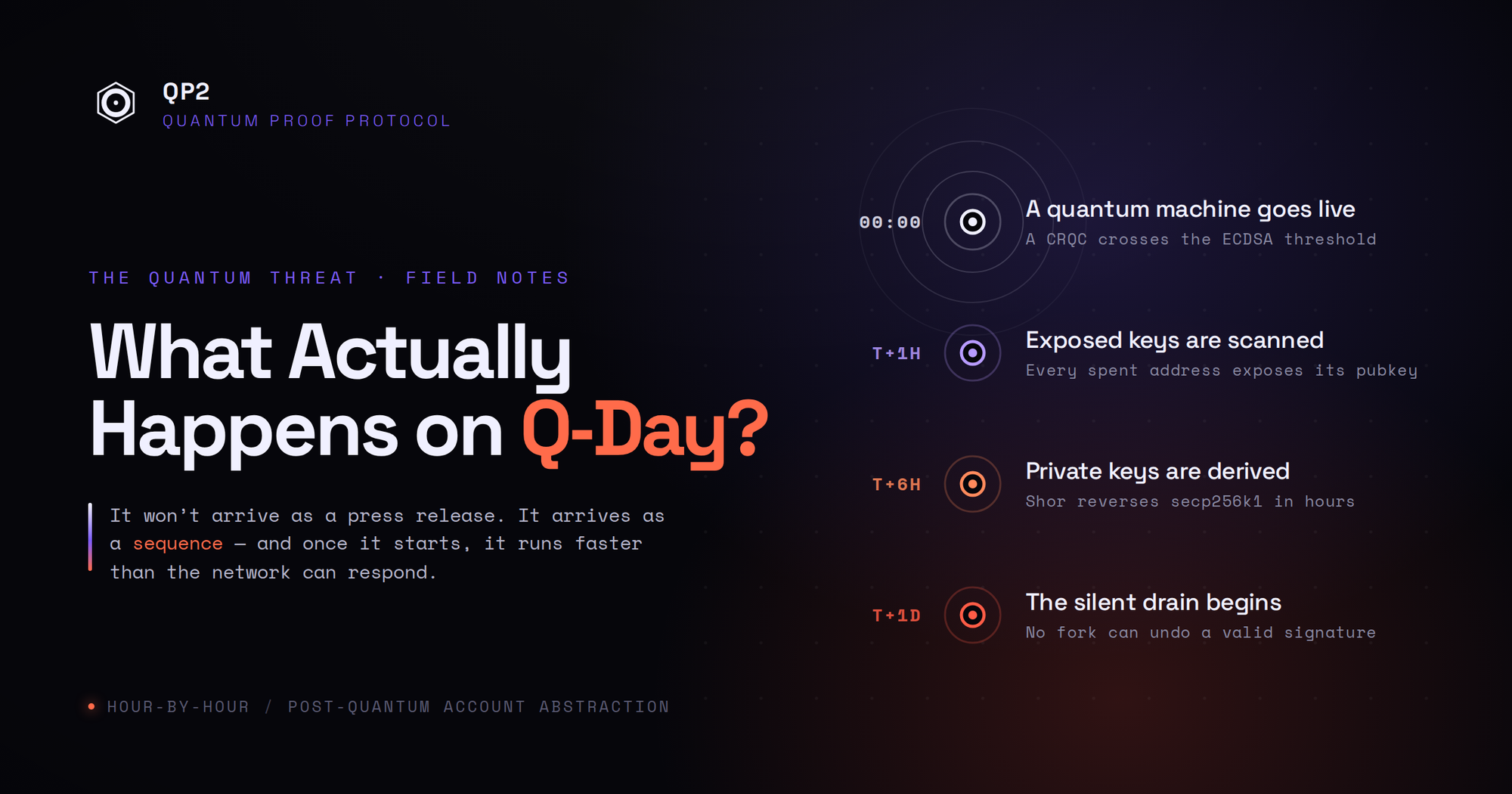
"Q-Day" gets thrown around a lot, usually as a vague, cinematic event — the day quantum computers arrive and crypto dies in a flash. That mental image is wrong, and the wrongness is dangerous, because it makes Q-Day feel like a single dramatic moment you'll see coming and react to in time.
You won't. Let me walk through how this actually plays out, because the realistic version is both less cinematic and far more unsettling than the movie version.
First, what Q-Day even means
Q-Day is shorthand for the day a cryptographically relevant quantum computer exists — one powerful enough to run Shor's algorithm against the cryptography we rely on today. For crypto specifically, it's the day a machine can derive an Ethereum or Bitcoin private key from a public key.
Note what that definition does not include: a press release. There is no reason to expect that the first capable quantum computer will announce itself. Which brings us to the first uncomfortable truth.
Q-Day might already be behind us before anyone admits it
Whoever builds the first capable quantum computer has overwhelming incentive to say nothing.
Think about who's in the running — nation-states, intelligence agencies, a handful of enormous, well-funded labs. If you were a state actor and you crossed that threshold, would you publish? Of course not. A working cryptographic quantum computer is the single most valuable intelligence and financial tool imaginable, and its value depends entirely on the world not knowing it works. The moment people know it exists, they start defending against it. So you stay quiet, and you use it.
This is why "I'll act when Q-Day arrives" is not a plan. Q-Day may not arrive with a date attached. It may arrive as a quiet capability that gets used carefully, on high-value targets, for a long time before anyone connects the dots.
A realistic timeline of the attack
Forget the flash-of-light version. Here's the slow, rational version.
Long before Q-Day — the harvest. Attackers archive the chain. Every exposed public key, every dormant whale wallet, every treasury — all of it copied and indexed, waiting. This costs almost nothing and is happening regardless. (We wrote a whole post on this — harvest now, decrypt later.)
Q-Day minus a while — the quiet phase. The first capable machine comes online somewhere, unannounced. It's slow and expensive to run at first, so it isn't draining random wallets. It's being pointed at the highest-value, lowest-noise targets. A dormant wallet that hasn't moved in years is perfect — nobody's watching it, and when it finally moves, it looks like the owner woke up, not like a break.
The tipping point — it becomes visible. Eventually the attacks get sloppy, or the hardware gets cheap enough to use at scale, and the pattern becomes undeniable. Funds start moving from accounts whose owners didn't authorize anything. Now it's public. Now it's a crisis.
The panic — everyone tries to move at once. Here's the cruel part. The instant Q-Day is confirmed, everyone rushes to migrate to quantum-safe accounts simultaneously. But migrating means making a transaction — which means exposing your public key and signing with your vulnerable key, in a mempool now actively watched by an adversary with a quantum computer. The act of fleeing is itself dangerous. The exits get crowded exactly when they're most hazardous.
Why "wait and react" loses
Put those pieces together and the conclusion is grim for the wait-and-see crowd:
- You probably won't get a clean warning, because the first mover has every reason to stay silent.
- By the time the threat is undeniable, the safe window to migrate has already narrowed.
- The migration itself — broadcasting a transaction signed by your at-risk key — is most dangerous precisely when everyone's trying to do it at once.
Reacting to Q-Day is, almost by definition, reacting too late. The only safe place to be is already migrated before the quiet phase even begins.
The only winning move is to be ready early
The lesson here isn't "panic." It's that this is a threat you have to be ahead of, because there is no reliable signal that tells you the moment to act, and the moment to act is well before the moment it becomes obvious.
That's the entire reason QP2 is built the way it is. The whole point is to let you move to quantum-safe security calmly, now, while it's cheap and safe — not in a stampede later. Because your QP2 identity is a contract with a swappable verifier, you upgrade your security without changing your address, on a quiet Tuesday, long before any of this plays out. When the quiet phase begins, your exposed key already controls nothing.
You don't get to choose when Q-Day happens. You do get to choose whether you're ready before it does.
Your address stays. Your security evolves.
QP2 — Quantum Proof Protocol. We're shipping to Ethereum mainnet — follow along. -> qp2.org
This article describes a plausible threat scenario for illustrative purposes and is informational, not investment advice.